If I told you there was an easy way to reduce stress, increase your immunity, and even your longevity, without giving up french fries, would you believe it? Volunteering can actually reduce risk of death by 24%. There’s actually research behind this.
I’m sharing this to explain the profound effect volunteering has on your well being. Of course, no one sets out to volunteer based on data or research- we do it because we want to help. Because we are grateful for what we have, and want to give back. Whether you share your knowledge, your time, or your money (or all of the above), it has the added benefit of triggering endorphins and triggers all kinds of positive effects on your biology.
Volunteering has always been an important part of my life, but it became an even greater part when I was grappling with empty nest syndrome.
When my kids moved out, I just worked more. I used distraction as an antidote for the massive volume of quiet in the house. Buried in work, I got through those first few months of wondering what I was going to do with my life, now that my focus wasn’t the tricky balance between work life and planning activities for the kids, college visits, multiple moves in and out of dorms, and the like.
It worked for awhile, but it wasn’t sustainable. Or advisable. So I had to really think about what to do. What did I do with my time before I had kids? What did I WANT to do with all this blank space in my life? How do I get involved with something meaningful, beyond the day to day routine? Before I had kids, I volunteered. Maybe I could do that. But where to start?
Well…as a kid, I loved horses. And I remembered something about equine therapy in the area, so I looked it up. Thus began a weekly routine of volunteering at an equine therapy farm.
I had some romantic idea that it would entail grooming and exercising the horses, or helping with the therapy sessions. Yeah, well, no. What they needed was volunteers to do the hard work of cleaning the the fields and stables (scoop horse poop), stuff bags of hay, fill and carry impossibly heavy buckets of water, and so on. Occasionally, I got to groom the horses and meet the veterans during their sessions. Every time I showed up, the farm cats would come running out of the barn, the horses would amble over to say hello, sometimes playful with each other and rolling in the mud, and it all gave me so much joy. I posted pictures of these boys every week as if they were my kids at the soccer game.
So this back-breaking work, in the sun, in the rain, in the cold, in the sleet…really sucked sometimes- I mean, I’m too old for this shit, really- so what had I gotten myself into? I don’t even do work like that at home! But it was amazing. And surprisingly, I was happier, slept better- and the effect on my work was amazing.
I found myself clearer, less stressed, more confident, and just…more joyful.

This was one of several volunteer gigs I took on. I didn’t think I had time for either, really- but the thing is, you make time for the things that matter. And I found, by making time for meaningful things, I was better at managing and deprioritizing things that weren’t essential. I simply had to plan my time more intentionally.
In The Book of Joy, an extraordinary five day interview with longtime friends, Desmond Tutu and the Dalai Lama, Doug Abrams explores the idea of living joyfully despite hardship and heartbreak. One key concept they share: when you give, you make room to receive, is remarkably true in all kinds of profound ways. In talking about generosity, referencing the research of neuroscientist, Richard Davidson, it says, “the reward centers of our brain light up as strongly when we give as when we receive, sometimes even more so.”
As humans, we are genetically wired to find joy in helping each other. How cool is that?
For inspiration in every aspect of your life, I highly recommend The Book of Joy. You can find it here, or in your local library.
About Jess: Longtime writer, business strategy consultant and one of the original web-mamas (coined by one of my early ecommerce teams), I help companies design and implement strategies to drive growth and improved customer experiences. For more info, see JessJacksonConsulting.com.
A strategy is just a dream if you don’t have a roadmap to follow.
Most companies have a vision, many have a strategy, but so many fail on the execution. Why is that? The most fundamental reason is because of a lack of clear plan, alignment, and change management. If a company has a brilliant strategy, but no roadmap for how to get there- or a lack of alignment across the organization, it isn’t a strategy. It’s a dream.
So let’s talk about how to structure your strategy:
Strategic planning
Articulate your Vision. Start with the end in mind. What do you want to be when you grow up? This can include a conceptual and/or a financial vision. Set your sights high.
Plan your strategy. It starts with workshopping and documenting these key concepts:
- Who are your constituents? What do they care about? How are you serving them today? How do you want to be able to serve them in the future?
- What data do you need to support the strategy? Market considerations, competitive set, and more.
- Where do you need to win to grow?
- What are the key gaps or areas that you need to build or fix to get there?
- Where do you need to innovate to deliver compelling value?
- What tools, technology, people and resources are needed to execute?
- What has to change? Processes, ways of working, mindset.
- Alignment: Cross functional commitment & alignment is a necessary step before ratifying your strategy.
Build your Roadmap
- Strategic plan & Timeline: build out a 1-3 year business roadmap showing the phasing, key projects, technology and features that will be delivered to support your strategy.
- Financials: what are the investment and return expectations for year 1,2 and 3? How are you going to drive value quickly, while building long term equity?
- Key requirements: what are the must-haves? The nice-to-haves?
- Operational needs: Activate the resources, tools and organizational requirements needed to support the first phase
- RACI: Who are the project sponsors? Who are the core team members? Who’s accountable for what? Responsible?
- Change management: This needs to start early on to ensure that you have organizational alignment, to enable teams to surface and address concerns or obstacles, identify processes and other challenges that need to be addressed to deliver each project successfully.
Begin to execute:
Once your strategic roadmap is complete, it’s time to execute. At a high level, you’d need to validate your roadmap to assess what’s achievable on your timeline. Align on what’s more important- timeline or budget.
- Validate your timeline and prioritization for phase 1
- Create detailed requirements & project plans
- Identify Program and project managers
- Identify Vendors or partners
- Validate RACI
- Change Management
- Identify test & learn strategies
- Scheduled check-ins and executive updates
- Meet quarterly to review progress against the roadmap, and to validate future phasing.
Assess & evaluate where you need to pivot. What has changed in the marketplace, company performance or other factors? What innovations could be gamechangers?
- Assess & evaluate your roadmap & timeline. Has anything changed that could (or should) impact your timeline or priorities? Consider market forces, company imperatives, innovation…
- You should be prepared to pivot and refine as you learn. Your roadmap is a guideline- not a fixed plan that is set in stone.
- Watch the scope creep- Your program and project managers should keep the team focused on project scope, but inevitably, new ideas will arise. MOST should be put in a prioritized backlog for future phasing. The core team needs to surface and evaluate ideas to determine whether they are in-scope, need to be prioritized for future scope, or worth adding to project scope- considering what you could remove from scope to keep the project on track.
That’s a starter list for you! Feel free to bookmark it.
I help companies of all sizes articulate brand vision, strategies- and to execute. For help with yours, see https://jessjacksonconsulting.com/
For more, watch this space.
In a post covid, WFH and Hybrid world
I’ve been thinking a lot lately about how we can better help recent graduates navigate getting work, succeeding in their first jobs out of school, and getting perspective on how to learn and succeed in a post-covid environment of hybrid and WFH.
As someone who did WFH long before it was a thing, I’m a believer in the effectiveness of remote work. I’ve led remote teams across multiple countries launching websites in North America, Europe, Australia and Asia. I have lifelong friends built on many hard weeks and months working and building things together. I miss seeing people IRL at work too, but I also love not spending 3+ hours commuting daily anymore.
For new grads, I think about the value of real-life interactions: of seeing, observing and learning from others that you may not encounter just doing your job. Of the chance encounters with leadership and people outside your world that can inspire and teach.
WFH can be great. But it can also be isolating if you’re not yet well connected, if you don’t have the hybrid experience to make new connections, or if you’re not in an environment that does it well.
It can be extremely isolating if you’re looking for your first job out of college, and don’t know how to start.
We have an obligation to mentor those who are new to the workforce- both in breaking into a world they don’t yet feel connected to, and also understanding that it’s a world hugely different world from the one we knew, as Gen Xer’s, or even as Millennials.
So how do we help?
1. Make yourself available to talk. It doesn’t have to be a lot of time. But as my Millennial daughter reminded me- it’s hard for Millenials and GenZers to ASK. Even harder to know how to ask in a way that will get a response. They may not even have a specific question. So offer it up. Tell the Linkedin community that you’re open to this. Respond to the LI in-mails asking for a quick conversation or an informational interview, or even a (gasp) cup of coffee.
2. Do what you would do in person– take the time to reach out and ask how your team members and co-workers are doing. If you see someone struggling, ask how you can help. You have to be more intentional about this when your team is remote. It is so important for your team members and teammates know that you see them.
3. Make sure everyone you know has community support. Phyl Terry has a great community built around asking for help- it’s called #neversearchalone and I’m a volunteer for that LinkedIn group, as well.
Let’s keep the dialogue going.
For the seasoned among us, what do you think? And how do you think we can help? Gen Zers & younger Millenials, what do you see, and what kind of help do you think is needed?
After a round of meeting great new vendors, exploring cool new tools & tech, I always think about how much room my clients have in my budget for these fun, experimental things. We’re all attracted to fun, shiny things. But as business leaders, are these always the panacea we want them to be? When we’re thinking about how to allocate precious budget $ to improving our websites, there’s push-and-pull between the foundational and the fun.
There are always new tools that promise better engagement, conversion or order value. Innovations that will increase brand value and improve the customer experience. Some of these are truly a value add.
But what good is a fun or beautiful front-end, if the underlying experience is bad?
The same is true in our personal lives. That shiny new buy isn’t going to change your life, though it may make you feel great in the moment. When the excitement wears off, you still have the same issues to deal with.
Last summer, I was planning a few home renovation projects. Not my favorite thing to do, but I love the result. It’s so much work: the planning, the product, color, and materials. The contractors. The coordination and disruption. Whenever we’ve talked about these bigger projects, I joke that I’d rather buy a new house that someone else already fixed up.
After two years of work-from-home, and daily visibility to the deficiencies of our laundry room, the main entry to the house from the garage, I was ready. Picture old, low-quality cabinets peeling at the edges, no longer flush, unpleasantly aged beige particleboard- yuck. It was dated, ugly and in disrepair. Our downstairs bathroom also needed an upgrade- tiles that keep pushing out the caulk, ugly striped wall-paper, and out-of-date everything.
But then while gardening out back, we noticed a deep foundation crack. One that used to be a hairline. The crack extended 15 feet, and was big enough that you could see sunlight from inside our furnace room, and feel outside air if you put your hand up to it.
For context, we live on a hill that descends into a creek. To protect the house, it’s a constant fight to keep erosion at bay. And after 25 years, the house was showing the wear.
We had to deal with it.
So we fixed the wall. It took 4 weeks of back-hoes, concrete destruction and reconstruction, leaving deep trenches through our back-yard and dust everywhere. During the tear-down, they told us that moving our old A/C units was a risk. Since they were ancient, decrepit, and inefficient, they recommended we buy new. They couldn’t guarantee that they would work if disconnected, moved and reconnected. But in light of the fortune we were investing in the foundation, we had little appetite for replacing those NOW. Let them hang on for one more summer.
When the work was finished, neither of the A/C units could be saved. One had been dropped. The other needed repairs so expensive, it wasn’t worth doing. So now, two days before the first 95 degree weekend of the year, we needed new A/C units. That was fun.
All in, we spent $20K on the foundation, then another $12K or so on the A/C’s. My renovation budget was gone- and then some. I really wanted that updated entry for the house. We were going to tear out a closet and make a more modern mud-room with a bench. And nicer downstairs bathroom.
But what good is a beautiful entryway to the house, if the house might slide into the creek? When we try to sell the house, what’s going to drive more value? A solid foundation, or a nicer mud-room? Shoppers might love what they see walking through and make the offer, but when the inspection is done- the foundational issues come to light, and many shoppers opt to simply back-out.
The same thing happens on your website.
Consider this as you plan your commerce & technology budgets. If you keep investing primarily on the superficial- the entry-ways, the cosmetic and feel-good moments, your technical debt gets bigger and bigger over time. Eventually, you’ll feel the pain. Conversion will stay flat or down. Only your most loyal or sale-conscious customers will persist.
We all love a little bit of fun. Branding matters. But customer experience is everything, from the beginning to the end. If a shopper loves shopping your product, but has trouble signing-in or checking out, your brand value takes a negative turn.
If your underlying foundation is cracked, all that good will just opts out.
Worthwhile read. “Dr. Maya Angelou once said, “When people show you who they are, believe them the first time.” She was and is exactly correct.”
I am scared. I am scared for my Catholic friends, my gay friends, my non-evangelical Christian friends, my women friends, my family and my Jewish community. The rise of Christian nationalism is threatening a basic tenet of our agreement as a United States, our founding principle of the separation of Church and State. But it gets worse: Christian nationalist rhetoric, excused as “free speech,” is profoundly dangerous.
Our government was founded on the principal that the government would neither prefer nor prevent any religion. Yet in the past few years with recent acceleration, the idea that this country was founded as a white, Christian nation (i.e., Christian nationalism) has begun to take root in our national debate. According to a recent University of Maryland poll, 17% of Democrats and 61% of Republicans support declaring the United States a Christian nation. The findings also indicate that “white grievance” plays a role…
View original post 1,377 more words

Is your brand as customer-centric as you think it is? Most leaders will say that the customer is at the core of everything they do. Yet, so many websites fall short on creating exceptional customer experiences. Creating a culture of customer-centricity involves every aspect of the customer journey: before, during, and after the sale.
Is your brand as customer-centric as you think it is? Take the quiz and see where you stack up:
- Is it easy to shop the site? Shop on the device most of your customers use, and score yourself against your most aspirational competitors. Is the site mobile optimized? Is it easy to contact customer support? Do you take mobile payments? Are returns easy? Hint: all those annoying things you haven’t had time to fix? They are friction points for your shopper. Friction=lower conversion. Removing friction points=opportunity to “wow” the customer. Getting the basics right matters more than the shiny new things.
- Is customer service empowered to make your customer happy? Can they solve the problem in one interaction? Can they make exceptions to policy without management approval? Your customer’s experience with the contact center will make or break her perception of the brand. Lose her trust here, and she’ll buy from a competitor next time. Delight her here, and you might create a customer for life. Empower your teams to do what’s right for the customer. Every time.
- Do you recognize and reward your best customers? Does everyone get the same treatment, or do you personalize based on shopping history, interests and activity? Do you have a loyalty program? Do you create value beyond promotions to inspire loyalty? Do you meaningfully support the causes she cares about? Do you recognize VIP customers when they call, chat or email?
- Do your customers shop with you again? What’s the average lifecycle of a customer? How many times does she buy per year, and what’s your LTV? How healthy is your email, SMS and organic traffic growth? If you’re buying new traffic without cultivating existing customers, you’ll be running on a very expensive (and unsustainable) hamster wheel.
- Do you listen to your customers? Do you ask your customers what they think? Are Voice of the Customer learnings shared regularly? Consider creating a customer panel comprised of your most loyal shoppers. Do you analyze the shopping funnel to understand drop-off points, and use both VOC and funnel metrics to drive your roadmap?
If you can’t say yes to all of these questions, it’s time to think about how you’ll begin to level-up. Here are a few tips to get you started:
Rule #1: Everyone in senior leadership needs to be shopping the brand as a customer regularly.
Rule #2: Create a customer-centricity report card and make sure you know where you stand.
Rule #3: Create a customer experience manifesto and make sure everyone across the organization exemplifies it at every touchpoint.
Rule #3: Don’t chase the shiny things at the expense of getting the basics right. The ratio should be basics: 80%, shiny things: 20% or less.
Customers have more choices than ever. Give them a reason to choose you.
The Great Resignation is real. We’re seeing a new mindset for how people think about, and value work.
Millions of people are quitting their jobs- to the tune of 4 million in July 2021 alone, with almost 11 million open jobs at end of July (Ian Cook for HBR, “Who is driving the Great Resignation?“), and in the past 6 months- resignations have accelerated.
Is this really surprising? We’ve had nearly two years of uncertainty, tragedy, and collective trauma with Covid. Now that we’re starting to come out of it, people are re-evaluating what they want. What they need. What matters. And guess what? It’s not working 12 hours a day for lousy pay. It’s not putting your life at risk to go sit in an office, socially distanced from your co-workers.
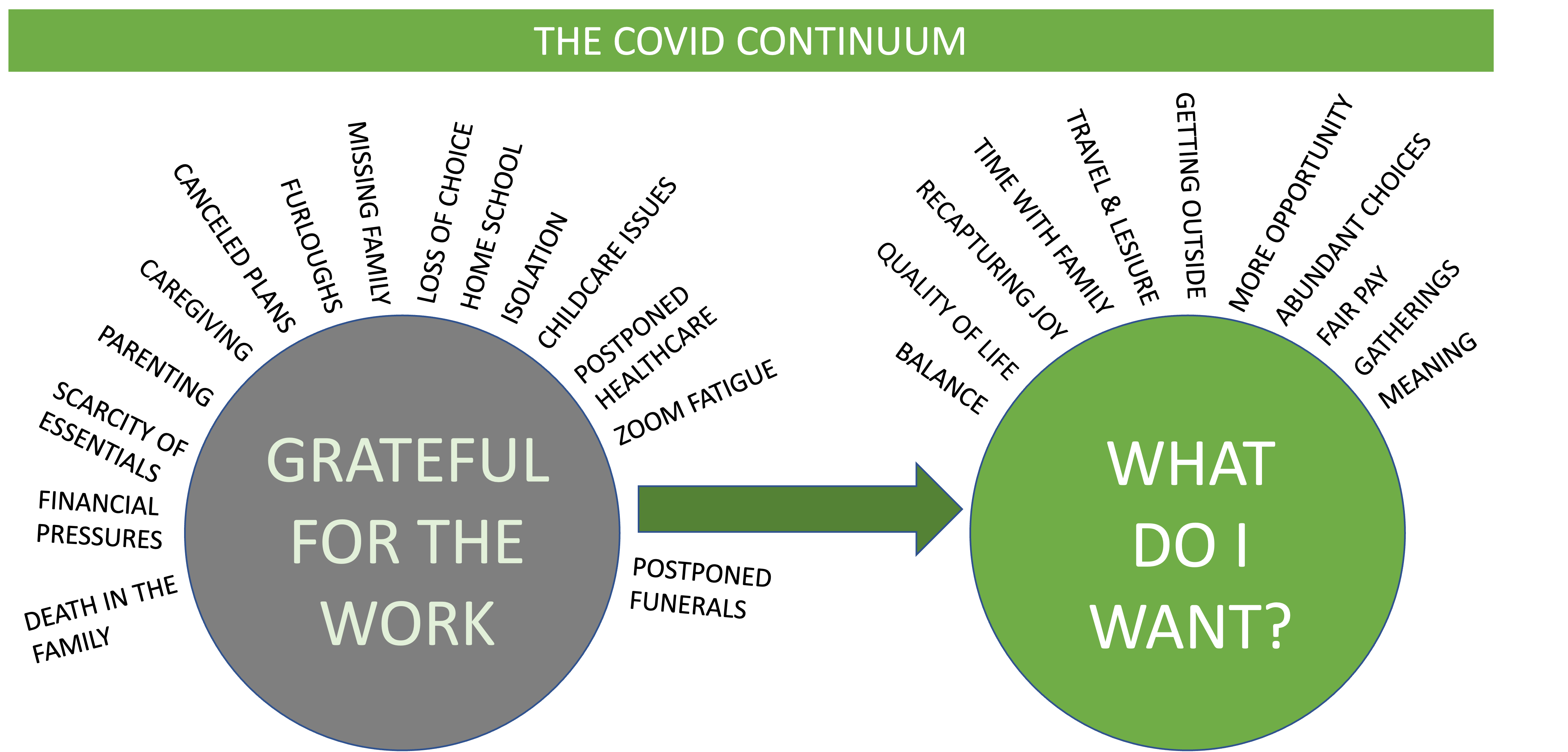
Think about the lowest wage segment- putting their lives at risk every day, in service industries, supply chain and health care- the jobs that could not be done virtually. Parents without other options for childcare simply had to pull out of the market, with schools closed and lack of childcare options. Burnout and exhaustion were a given. There’s a collective trauma- an element of PTSD at play. It’s not surprising these industries are now facing staffing shortages.
For those who were able to work virtually, many were doing the jobs of 1-3 roles, with downsizing, furloughs, and budget cuts over the past 18 months. This, while juggling home-schooling, childcare, family care, isolation, financial stress and more. It’s been a grueling time for those lucky enough to have the work.
As some companies mandate strict ‘back to office’ policies, there’s a real disconnect with employees who don’t want to give up the flexibility of working from home- better balancing their time, and skipping long commutes. They don’t want to go back to the way it was. And they don’t have to.
…”this level of quitting is really an expression of optimism that says, We can do better.”
Derek Thompson for The Atlantic: The Great Resignation is Accelerating.
Derek Thompson talks about the job exodus as a new feeling of empowerment, in his Atlantic article, The Great Resignation Is Accelerating, saying “this level of quitting is really an expression of optimism that says, We can do better.” This is an awakening. Thompson calls it the “Great Reset.” For leaders and managers- it’s an opportunity to evolve and be competitive- or risk continued attrition.
So how do we attract and keep good people? Pay them fairly. Set reasonable expectations. Give them a reason to want to work for you. We all know minimum wage is not a living wage: don’t start there.
It matters more than ever that you’re running a company that listens, and truly cares about your people. Just saying you do isn’t enough. They know the difference.
It matters that you pay what your people are worth.
It matters that you are flexible. Some people simply don’t feel safe coming into the office yet. If you’re not flexible about this, know that others are, and you’re now competing with the entire country- not just your geographic area.
It matters that you make an effort to create paths for growth and advancement.
And more than ever, you need to think about your employees the way you do about your customers: Authenticity, good experience and brand values matter. How your leadership and actions demonstrate these values in every touchpoint with your customers- internal and external, matters. Your customers have a choice. You need to give them a reason to believe in you.
Sources:
The Great Resignation Is Accelerating: Derek Thompson, The Atlantic
Who Is Driving the Great Resignation: Ian Cook, Harvard Business Review
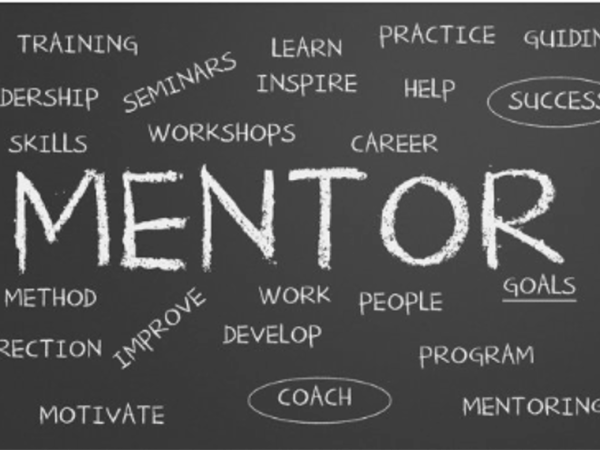
I’ve learned as much from the good bosses I’ve had as I have from the bad. The good ones challenged me, empowered me, helped me to see the bigger picture- showing me the 10,000 foot view when I was still wading through the surf, gave me perspective, objectivity, genuinely cared about me and saw my potential. But guess what? The bad bosses did too, for the most part. It was just less pleasant, and sometimes downright painful. All of it was instructive.
That was my earliest lesson in leadership. By watching, learning and listening, I thought about who I did and didn’t want to emulate. I found I’d work twice as hard, twice as long, and deliver better work for leaders who helped me understand why we were doing something, why it mattered, showed me the greater purpose and how I could make a difference. That was the leader I wanted to be.
In the first brand I worked for, I’d worked my way up from an entry level role to a leadership one. It had been an amazing journey. When I was offered an opportunity for a new role, managing the transition to digital commerce, I was all in. I’d been the one who pitched our CFO on moving to digital design, saving hundreds of thousands of dollars. Selling online was the dream. But one long time mentor said, “Why would you leave? It’s a huge risk. What if it fails?”
It wasn’t unreasonable. These were early days for E-commerce: picture Amazon as a mostly text site full of blue-underlined links. If this new business didn’t drive results, we could get shut down, and then where would I be? I called a trusted C-level executive and asked for advice. Was I making a terrible mistake? He said, among other things: “You have to think about what’s going to make you excited to get out of bed in the morning. What do you WANT to be doing?”
One was the voice of fear, the other, the voice of empowerment. One encouraged me to stay in my comfort zone, the other, to grow. My most inspiring mentors in that time expanded my worldview in a way that felt a little bit like helping me to leave home. Exciting- but scary. And ultimately led me to find my niche and passion in the world: digital commerce.
I’ve sought to do the same for others that worked for me over the years. Be approachable. Listen. Teach. Provide context and the bigger picture. And just like I’ll never forget the mentor who empowered me to find my dream, I occasionally hear from someone whom I’ve helped. One day, I got a text from a former team member saying,
“I don’t think I ever told you how grateful I am that you hired me, supported and developed me. You changed my life and gave me so many gifts!! I’m very appreciative and want you to know the amazing impact you had on my life. Thank you.” Wow. Just wow.
I still hear the voices of the ones who were most meaningful to me, who helped me become the leader I am today. I continue to learn from trusted colleagues and mentors to this day. And I will keep paying it forward. I hope you will, too.

About Jess Blogs:
Jessie Jackson is an eCommerce leader, with a passion for making the websites we use better.
Better for customers = better for business.
As #Coronovirus charges around the globe, so many stories emerge. The give-you-chills kind, where people are helping neighbors and strangers, alike, and the make-you-boil stories, like:
- The profiteering guy in the NY times today, who took a 1300 mile road trip to buy out all the hand sanitizer stock he could find, and then sold it on amazon at a 7000% markup, telling his story of woe- how he got suspended from selling on Amazon (good for Amazon). There were, sadly, a lot of these. Last week, I saw a 5-pack of 1 oz hand sanitizers selling on Amazon for $98-just shameful.
- The guy who took the last container of clorox wipes out of my daughter’s hands in the grocery store, and walked away.
- Videos of people fighting over toilet paper (what universe is this we’re living in?)
- Pictures of people buying what looks like a lifetime supply of toilet paper (why???)
But there are bright spots too- lots of them. Check out #thekindnesschallenge on facebook. At first I thought this was a trite group- people humble-bragging. And it is, a little. But during a frightening times- it’s hopeful and encouraging to see people making an effort to help each other. Here are a few I’ve seen lately on facebook & twitter:
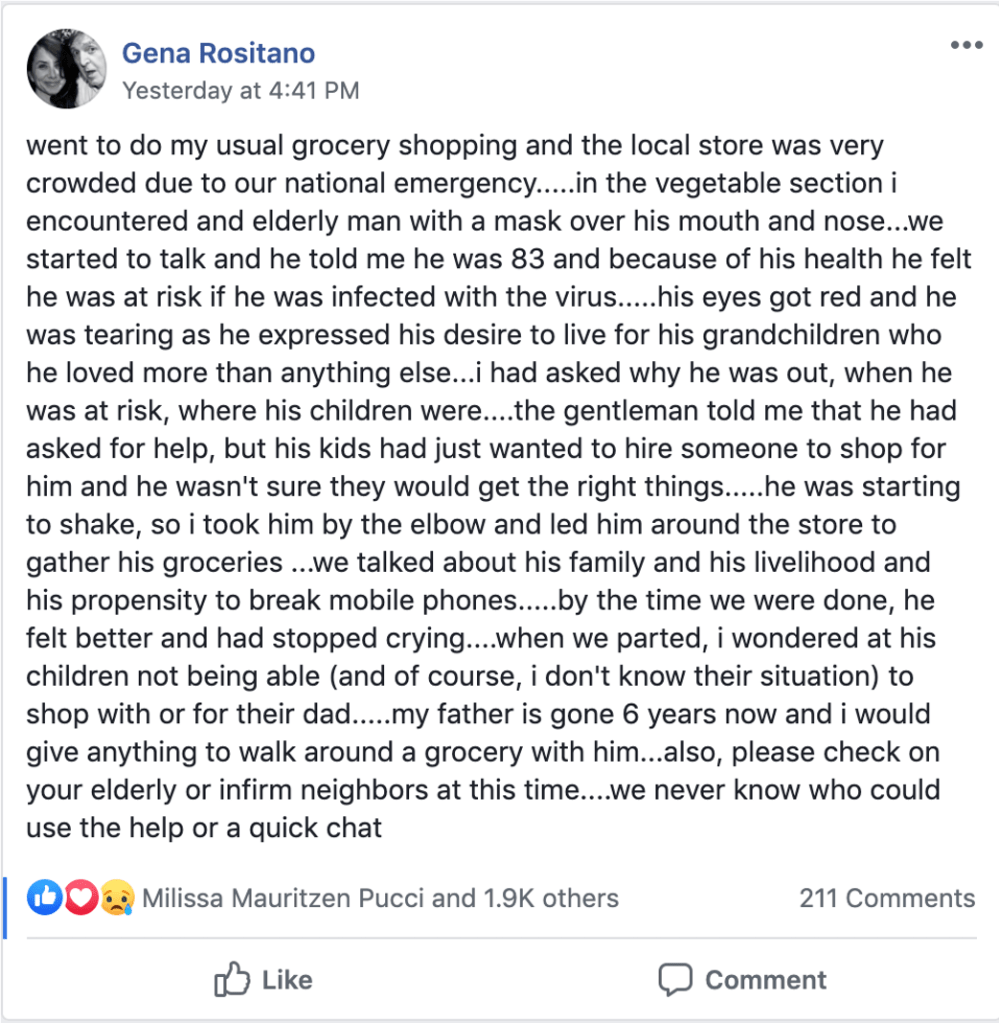
- Gena Rositano, a woman who stopped an elderly gentleman, who was in tears in the grocery store, and helped him get his shopping done.
- The person in the hospital who couldn’t afford the prescription, and the doctor filled it for him without a charge.
- Rebecca Mehra noticed an elderly couple sitting in their car outside the grocery store, and asked if they needed help. They were scared to go in. She bought their groceries and delivered them to the car. Her story has since gone viral, and was featured on CNN.
This gave me the idea to post on my community group on facebook offering to pick up food, prescriptions or other necessary items for anyone homebound/self isolating- and immediately got dozens of other volunteers to do the same.
These are the things that elevate us, lift our hearts, keep on going. There’s lots of scary, bad news out there. But there are bright spots too. Keep finding them. Be part of them. This is where a little humanity can go a long way.

Last week, Anthropologie had what can only be described as every brand’s worst nightmare- a delivery snafu that went viral on twitter, first as an amusing story- and then as a customer experience gone terribly wrong, when Anthro’s response devolved from amused and supportive, to unreasonable and threatening- the antithesis of a good customer experience.
Leah Rachel von Essen, posting as @reading_while on twitter, shared her story about the vase that never arrived, and her resulting re-order. Instead of delivering the vase, Anthropologie shipped her 9 huge boxes of unrelated products, including a 20 lb candle, a feather coat, and a strange golden hand. And then demanded she return them all- or risk being banned and billed for the merchandise she hadn’t ordered- and didn’t want.
Had they handled it well, this could have been a great customer experience and a social media win for Anthro. Instead, one mis-directed social media post later, they quickly turned it into a cautionary tale about how NOT to respond to a brand snafu online- quickly going viral on twitter, resulting in thousands of supporters, including a lawyer offering to intervene on Leah’s behalf, and getting picked up by Forbes, as This is The Best Retail Story You’ll Read all week. And indeed, it was.
The moral of the story is: every single interaction with your customers matters. And every single employee of the brand is a brand ambassador with the capacity to help, or hurt the brand’s reputation. Every interaction. Every customer. Make sure that your people know this, and are empowered to do the right thing. In the end- Anthropologie did the right thing. But the damage was done.
It’s worth reading the entire thread.
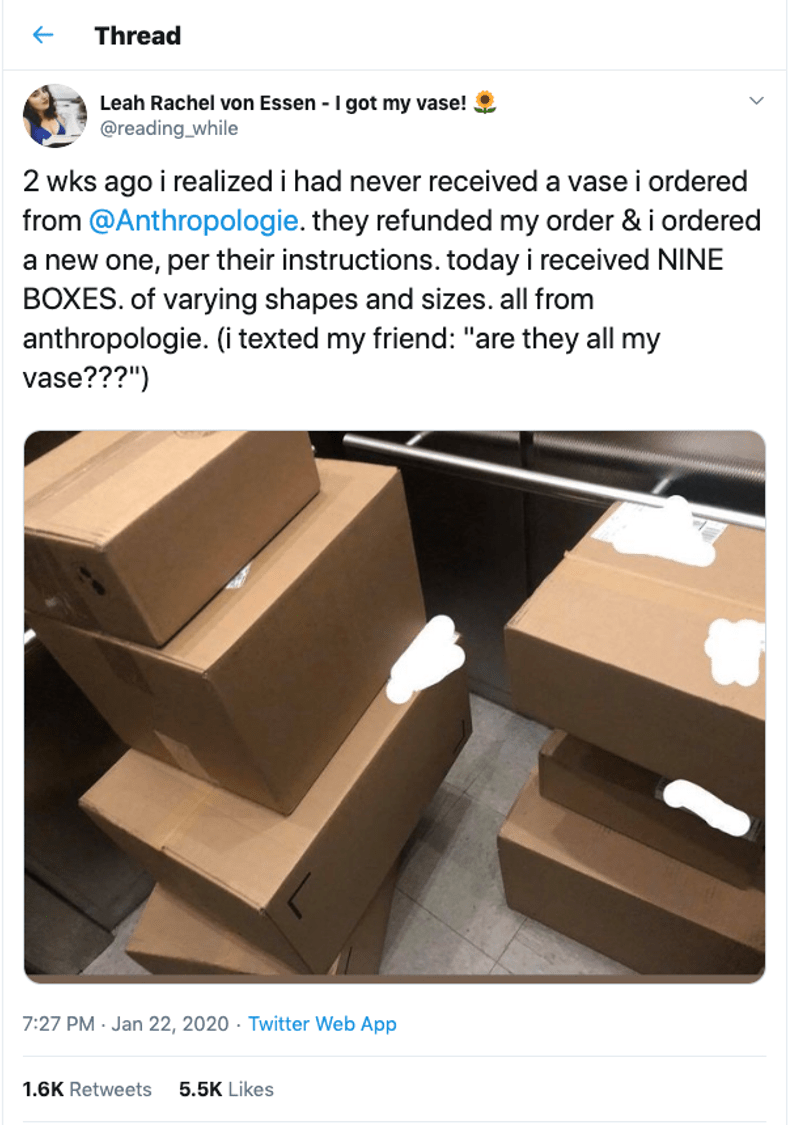
Leah is a book reviewer and blogger, who made this story such epic fun on twitter. You can see more of her writing on While Reading and Walking


 jess blogs